Ecosystems do not adhere to the artificial boundaries between countries that we have created. Rather, they extend beyond national borders. This is particularly evident in our oceans, which cover 71% of the Earth's surface and are interconnected by global maritime currents. Estimations are they produce every other breath of oxygen we take, act as a significant CO₂ sink and slow down the effects of climate change by storing large quantities of heat. But, oceans are also home to some of the most fascinating life forms on our planet.
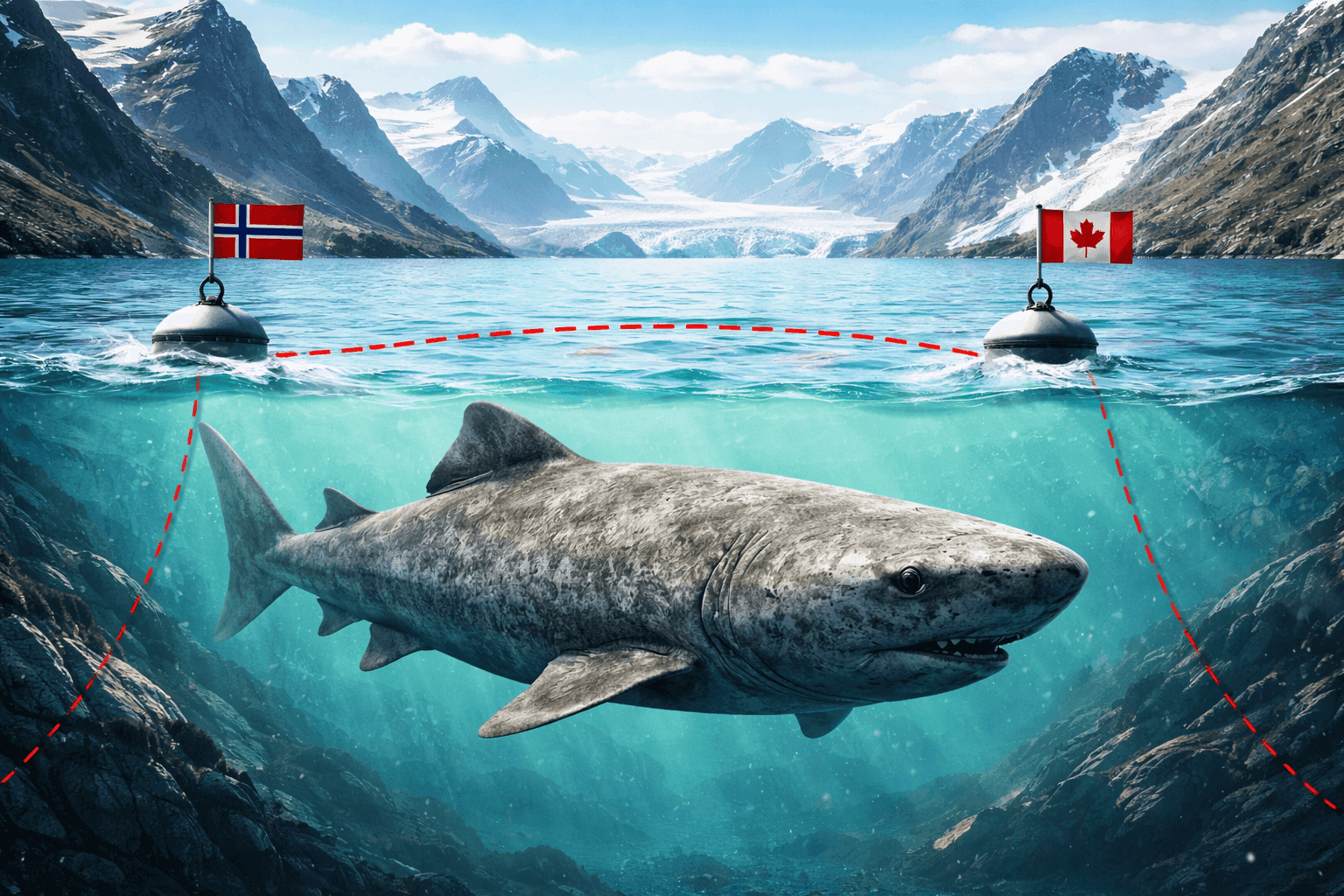
One of these is the Greenland shark, a species that is only little studied and lives in the depths of the Arctic waters. With an estimated life expectancy of up to 400 years, it is considered the longest-living vertebrate on the planet. Improved DNA repair mechanisms are believed to be the reason for this longevity and so, naturally, the animal is of great interest to scientists, as its mastering DNA repair may lead to a better understanding of ageing processes and age-related diseases.
However, the Greenland shark is not only biologically fascinating but, surprisingly, also appears in German legal history. Many lawyers may already have encountered it in connection with the 'Haakjöringsköd' (the meat of the Greenland shark) case, which to this day remains a well-known example in contract law on the interpretation of declarations of intent under §133 of the German Civil Code (BGB): The case constitutes a textbook example of the principle falsa demonstratio non nocet ('a false designation does not harm'), meaning that, a wrong designation is harmless to the validity of a contract if both parties understand it the same way and are nevertheless in agreement about it.
So much about the "life" of the Greenland shark in the German legal practice.
In the maritime world, while states can designate protected spaces in their own territorial waters, there has long been a lack of comparable legal instruments to extend protective measures to the high seas. So how could such habitats be better protected, given they seem to be home to not only interesting but potentially also life-saving creatures?
The UN High Seas Protection Agreement (Agreement under the United Nations Convention on the Law of the Sea on the Conservation and Sustainable Use of Marine Biological Diversity of Areas beyond National Jurisdiction short BBNJ Agreement), which entered into force on January 17, 2026, now establishes a legal framework that covers the protection of the oceans beyond national maritime borders ('areas beyond jurisdiction').
But what does this mean? According to the BBNJ Agreement, 'areas beyond jurisdiction' refers to all marine areas that are outside the jurisdiction of any individual country. This includes the high seas and the international seabed—altogether accounting for over two-thirds of the world's oceans.
Under international law, the high seas are defined in the United Nations Convention on the Law of the Sea as including all parts of the oceans that do not belong to the exclusive economic zone (EEZ), the territorial sea, or the archipelagic waters of a state (Art. 86 UNCLOS). A key principle is that no state can claim sovereignty over any part of the high seas—the resources of the high seas belong to everyone and no one, and the international seabed is considered the 'common heritage of humankind'.
The BBNJ Agreement now closes a legal gap by creating the possibility of designating marine protected areas in just these regions, beyond national jurisdiction. In particular, environmental impact assessments must be carried out before any activities can take place in the ocean and fair and equitable use of genetic resources in these areas is regulated.
However, unfortunately, the mere signing of the BBNJ Agreement is insufficient of it to unfold its effects; rather, it must also be ratified by the countries, thereby expressing their consent to be bound under international law. Only after ratification is a country obliged to comply with the agreement's provisions. By January 2026, 145 UN member states have signed the agreement and more than 80 have even ratified it. By April 2026, while Germany is said to be in the final stages of the ratification process, the ratification has not yet concluded. I dearly hope, this will not take as long as the ratification of the UPC agreement!
You may wonder why we report about this absent its link to IP: although we deal with the protection of intellectual property in our professional lives, as biologists, the protection of the oceans is a matter close to my heart.
Sources: https://www.un.org/bbnjagreement/en/bbnj-agreement/about-agreement
The image used in this blog post was generated using publicly available artificial intelligence.


- March 27, 2026
 March 19, 2026
A New Era for Computer-Implemented Inventions in Australia
Australia’s Federal Supreme Court (the ‘High Court of Australia’) dashed hopes for greater clarity in the patentability of computer-implemented inventions when, in 2022, it handed down a 3–3 split decision in _Aristocrat Technologies Australia Pty Ltd v Commissioner of Patents_ ([2022] HCA 29).

New legal framework for NGT (new genomic techniques) plants and easing concerns on the issue of their patentability
Just before the end of 2025, the EU Parliament and the EU Council reached an exciting agreement that should lead to a novel uniform legal framework for new genomic techniques (NGT).